
_ _ Infobelt
Preparing Legacy SAP Data for S/4HANA Transformation: How to Manage Historical Records
Organizations preparing for an SAP S/4HANA migration should not move decades of inactive data into the new ERP or pay to keep legacy systems running indefinitely. The most cost-effective and compliant strategy is to separate active operational data from inactive historical records. This means migrating active processes to S/4HANA while moving historical transactions, documents, and attachments into a governed, searchable archive prior to cutover.
SAP S/4HANA programs typically focus on modern architecture, process redesign, and cloud deployment. Yet many transformations stall, run over budget, or face audit delays because teams overlook one critical question. What happens to decades of historical SAP data?
While active business processes drive daily operations, the bulk of legacy ERP databases consists of inactive records, such as closed sales orders, historical financial postings, SAPscript texts, and ArchiveLink attachments. Migrating all of this data into S/4HANA inflates HANA memory costs and extends downtime. Deleting it violates tax, legal, and regulatory retention mandates.
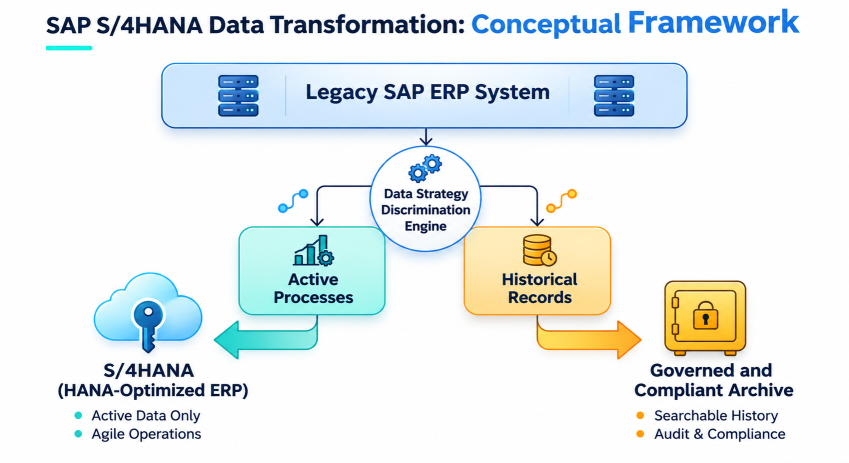
Leading enterprises solve this by treating S/4HANA transformation as both an application upgrade and a data modernization initiative. This is detailed in the following architectural workflow.
What is the Historical Data Challenge in SAP Migrations
SAP landscapes running for 10 to 20+ years accumulate massive volumes of static information. This includes:
- Historical financial transactions and tax records
- Legacy customer, vendor, and employee master data
- Closed sales and purchase orders
- ArchiveLink repositories, attachments, and SAPscript text data
- Regulatory and audit logs
Business users rarely access these records daily, but finance, legal, and audit teams must retrieve them on demand for years. When planning an S/4HANA transition, organizations face three options:
Strategy |
Core Approach |
Primary Drawbacks |
|---|---|---|
Migrate Everything
|
Lift and shift all historical and active data into S/4HANA.
|
Inflates SAP HANA storage costs, lengthens migration windows, and increases testing scope.
|
Keep Legacy Systems Running
|
Maintain old SAP ECC systems in read-only mode for historical lookups.
|
Incurs ongoing licensing, infrastructure maintenance, security patching, and aging tech risks.
|
Separate & Archive
|
Migrate active data to S/4HANA; move historical data to an external archive (as shown in Figure).
|
Requires upfront data classification and archival setup, but delivers the lowest TCO.
|
Why Historical Data Does Not Belong in Production S/4HANA
A common misconception is that historical records must stay inside a live SAP stack to remain usable. In practice, finance teams, auditors, and legal departments only need searchability, reporting, and proof of compliance, not the underlying legacy ERP application.
By decoupling historical data from production systems, enterprises can decommission legacy SAP landscapes. This shrinks their S/4HANA database footprint and cuts ongoing infrastructure expenses without losing access to vital business history.
How to Ensure Retention and Regulatory Compliance
Legacy SAP data is routinely governed by strict tax, labor, and industry retention laws. Simply moving files to cold cloud storage does not satisfy audit requirements. A compliant SAP archiving strategy requires active governance controls.
- Policy-Driven Retention: Automated rules that enforce minimum and maximum retention periods by document type and jurisdiction.
- Legal Holds: The ability to suspend scheduled deletion immediately during litigation or regulatory investigations.
- Immutable Storage: Write-Once-Read-Many (WORM) storage support to prevent tampering or premature deletion.
- Audit Trails & Disposition: Complete logging of who accessed, modified, or legally disposed of records.
Keeping Archived SAP Data Accessible Without Legacy Systems
Stakeholders often worry that archiving data means locking it away where it cannot be found during an audit five years later. Modern enterprise archives eliminate this bottleneck by indexing metadata and content for direct self-service retrieval. Teams can run full-text searches across archived documents, execute queries on structured legacy datasets, and generate audit reports through role-based access controls. All of this is possible without restoring a legacy SAP system.
5 Steps to Prepare Legacy SAP Data Before Migration
Organizations achieve faster, lower-risk S/4HANA cutovers by executing a structured pre-migration data strategy.
- Audit and Inventory Data: Map your existing landscape to separate active operational records from historical transactions, compliance-bound files, and obsolete data.
- Classify by Business and Legal Value: Categorize datasets based on access frequency, operational relevance, and statutory retention mandates.
- Define Retention and Disposition Rules: Align retention schedules with legal, tax, and industry compliance policies before moving data.
- Archive Historical Data Pre-Migration: Offload inactive records before cutover to shrink database volume, shorten migration downtime, and reduce testing cycles.
- Validate Search and Audit Access: Confirm that finance, legal, and audit teams can query and extract archived records independently post-migration.
The Role of AI in Archived Enterprise Data
Historically, archived ERP data sat in isolated silos disconnected from analytics. Today, modern archival platforms apply artificial intelligence to make historical records immediately actionable. AI-powered query capabilities let business users search and extract insights from archived datasets using natural language rather than writing complex queries. As enterprises expand AI adoption, governed historical SAP data shifts from a passive compliance burden into an accessible knowledge asset.
Driving Holistic Transformation Beyond Technical Upgrade
A successful S/4HANA transformation is measured not just by go-live, but by the efficiency of the architecture left behind. Moving every legacy record into a new ERP carries yesterday’s technical debt into a modern platform.
Addressing historical SAP data early allows organizations to reduce S/4HANA infrastructure costs, retire legacy systems safely, enforce strict regulatory compliance, and maintain fast, AI-ready access to decades of enterprise history.
How Infobelt Can Help
The data separation workflow described in Figure is a core methodology Infobelt implements for complex SAP S/4HANA transformations. Infobelt’s Infobelt Essentials for SAP is designed precisely for this challenge. It provides the compliant, high-performance, and AI-powered archive needed to house decades of inactive SAP data.
Infobelt helps organizations execute the five-step preparation process, leveraging OAM to index historical SAPscript texts, ArchiveLink attachments, and structured transactional data for instant, role-based access post-migration. By using Infobelt to decommission legacy systems and manage retention, enterprises can significantly reduce their S/4HANA footprint, ensure defensible compliance, and accelerate their overall transformation timeline.