
_ _ Infobelt
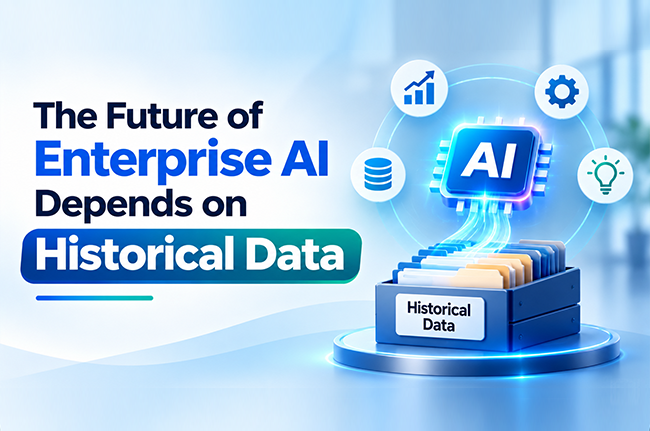
The Future of Enterprise AI Depends on Historical Data
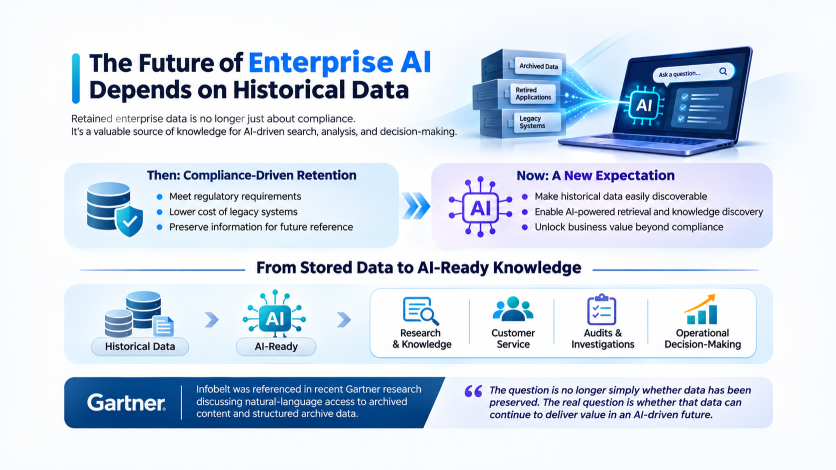
For years, data retention has been viewed primarily through the lens of compliance. Organizations archived data to satisfy regulatory requirements, reduce the cost of maintaining legacy applications, and preserve information for future reference.
AI is changing that perspective.
Today, organizations are asking a different question: not just whether historical data has been retained, but whether it can contribute to AI-driven search, analysis, and decision-making.
A New Expectation for Data Retention
As AI becomes part of everyday business operations, access to trusted enterprise information is becoming increasingly important.
Many organizations have decades of business records stored across archives, retired applications, and legacy systems. These datasets often contain valuable operational knowledge, customer history, financial information, and business context. However, if that information cannot be easily discovered and understood, its value to AI initiatives remains limited.
A recent Gartner research note on AI and data retention highlights how organizations are beginning to modernize their approach to archived information. Rather than treating archives solely as storage repositories, businesses are exploring ways to make retained data more accessible for AI-powered retrieval and knowledge discovery.
From Stored Data to AI-Ready Knowledge
One of the challenges facing many organizations is that historical information often remains tied to aging applications, specialized interfaces, or technical knowledge that only a few people possess.
AI changes user expectations.
Business users increasingly expect to ask questions in natural language and receive meaningful answers, regardless of where the information resides. This creates new opportunities to rethink how archived data is accessed and used across the enterprise.
The ability to connect AI technologies with retained business information can help organizations extend the value of historical data beyond compliance, supporting activities such as research, customer service, audits, investigations, and operational decision-making.
An Evolving Industry Conversation
What makes this shift particularly significant is that it is becoming an industry-wide discussion. Organizations are no longer viewing retention, application retirement, and AI as separate initiatives. Increasingly, these efforts are converging around a common objective: ensuring that valuable historical information remains available and useful long after the original application has been retired.
We were pleased to see Infobelt referenced in recent Gartner research “Use AI to Modernize Data Retention and Archiving (August 2026)” discussing natural-language access to archived content and structured archive data.
More importantly, the recognition reflects a broader market direction. As enterprise AI adoption grows, organizations will need to think differently about retained information. The question is no longer simply whether data has been preserved. The real question is whether that data can continue to deliver value in an AI-driven future.