
Beyond Retention: Making Historical Data Accessible, Understandable, and Actionable
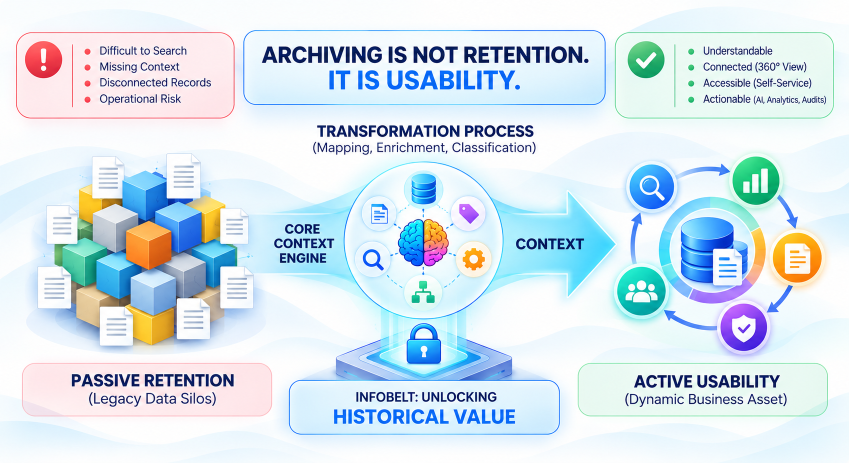
- Missing metadata tied strictly to legacy platforms
- Legacy codes and abbreviations without accessible data dictionaries
- Incomplete technical and business documentation
- Image-based or scanned records lacking full-text indexing
- Information locked in unstructured content (PDFs, raw logs, legacy report files)
Infobelt Perspective: The goal is not just to preserve data, but to preserve its meaning.
- Customers and master profiles
- Purchase orders, line items, and invoices
- Contracts, amendments, and sign-offs
- Claims, policies, and supporting payouts
- Financial transactions and ledger entries
- Supporting unstructured documentation and attachments
Key Message: Information becomes significantly more valuable when relationships are preserved alongside the data itself.
- Search naturally across both structured databases and unstructured document stores
- Ask conversational questions rather than writing complex SQL or legacy scripts
- Retrieve historical answers quickly without requiring specialized IT assistance
- Access information seamlessly while maintaining robust role-based governance, legal holds, and audit logging
Infobelt Perspective: Organizations should be able to retire the application without losing access to the information.
- Regulatory audits and tax reviews
- Legal holds and eDiscovery investigations
- Customer service inquiries and historical lookups
- Advanced enterprise analytics
- Enterprise AI initiatives and retrieval pipelines
Key Message: Information creates value when it can support decisions, not simply when it is stored.
If not: Preserve entity relationships, object linkages, and transactional context.
3. Can users easily access what they need?
4. Can the information support business outcomes?
Infobelt helps global organizations retire legacy systems, ensure compliance, and unlock the value of historical data. With solutions like Omni Archive Manager (OAM™) and the Application Retirement System (ARS™), Infobelt enables enterprise teams to preserve complex relational context, enforce defensible compliance, and empower business users with natural, AI-assisted access to historical records.