
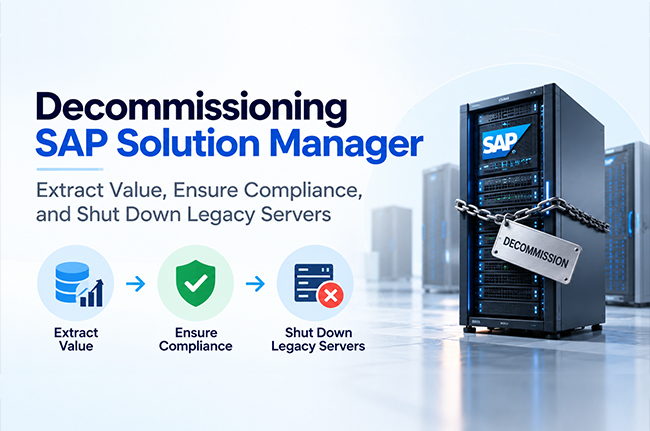
Decommissioning SAP Solution Manager: Extract Value, Ensure Compliance, and Shut Down Legacy Servers
Change Request Management (ChaRM): Controlling, tracking, and approving software transports, patches, and code changes across development, testing, and production environments.
Application Operations & Monitoring: Collecting performance metrics, system alerts, job logs, and root-cause analysis data for SAP and connected third-party systems
Ongoing Infrastructure Overhead: Retaining read-only SolMan virtual machines or physical hosts consumes cloud storage, compute capacity, and backup resources.
Maintenance & Security Liabilities: Operating legacy operating systems and underlying databases requires continuous patching, security monitoring, and vulnerability management.
Licensing & Operational Complexity: Maintaining legacy infrastructure diverts budget and engineering time away from strategic initiatives like SAP S/4HANA migrations and Clean Core alignment.
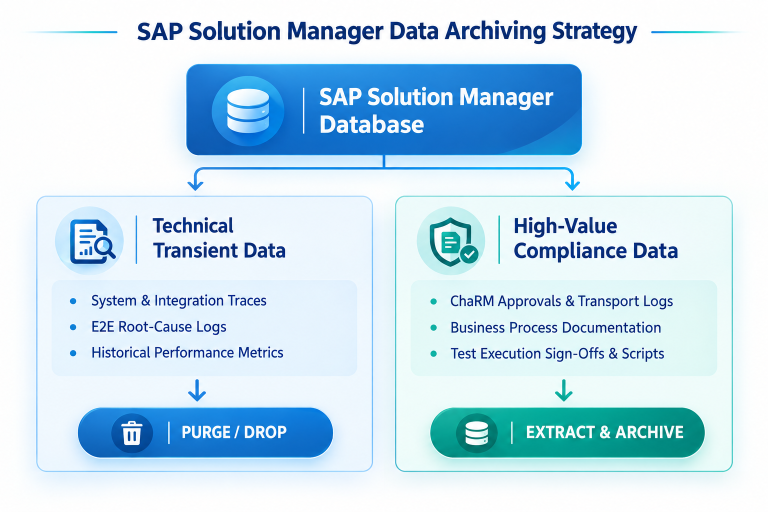
Change Request Management (ChaRM) Audit Trails: Transport histories, change approvals, functional sign-offs, and release records required for SOX and regulatory audits.
Business Process Documentation: Process flow definitions, custom specifications, and functional blueprints.
Test Suite Records: Execution logs, sign-offs, and compliance verification histories.
A 3-Step Playbook for SolMan Decommissioning
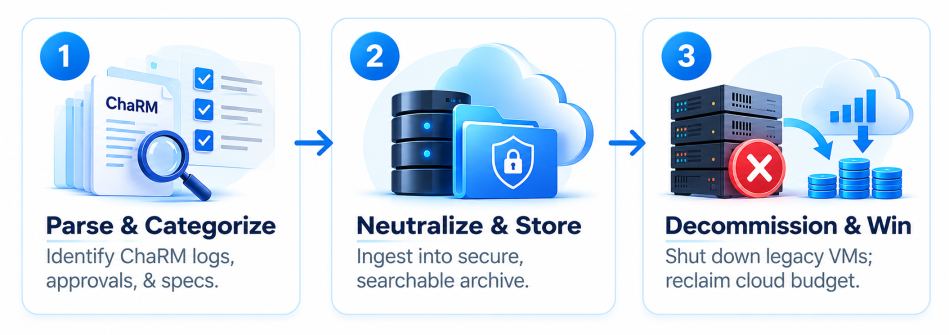
Transfer historical records into a lightweight, vendor-neutral archive platform—such as Infobelt. Converting proprietary tables into standardized, searchable data structures ensures long-term accessibility for internal and external auditors without relying on active SAP application servers.
Using Infobelt Omni Archive Manager (OAM™), organizations can ingest both structured relational records and unstructured attachments into a single, unified archive platform. OAM applies automated full-text indexing, metadata enrichment, and WORM (Write Once, Read Many) tamper-proof protections across all extracted SolMan artifacts—ensuring complete document-level searchability during regulatory audits.
Infobelt’s proprietary Archive Query Language (AQL™) eliminates the need to restore archived files or re-spin up SAP application servers. AQL enables authorized teams to query, filter, and extract high-value historical records directly from compressed and encrypted storage tiers. Whether compliance auditors need specific ChaRM approval records from five years ago or transport histories across past release cycles, results are returned on demand while leaving underlying legacy servers permanently powered off.
Infobelt AQL-Copilot™ brings Generative AI and Natural Language Processing (NLP) to historical enterprise archives. Through an intuitive ChatGPT-like conversational interface, compliance officers, business users, and IT managers can ask natural language questions in plain English—such as “Show all approved ChaRM transport requests for Finance releases in Q3 2024”.
AQL-Copilot dynamically analyzes the underlying archive data model, generates and executes the appropriate queries behind the scenes, and presents ready-to-export audit reports in formats like CSV, JSON, or SQL—slashing audit response times from weeks to seconds while maintaining fine-grained security controls and sensitive data masking.
- For CIOs & Financial Leadership: Predictable cost reduction by eliminating ongoing cloud hosting, database licensing, and operational maintenance for legacy servers.
- For Enterprise Architects: Complete alignment with SAP Clean Core strategies by decoupling active operational tooling from legacy compliance data.
- For Infrastructure & Storage Teams: Instant reclamation of storage capacity and virtual infrastructure, simplifying overall environment management.
- For Compliance & Audit Teams: Fast, centralized, and searchable access to historical ChaRM approvals and transport logs in a tamper-evident system.
Planning your SAP Cloud ALM transition? Contact Infobelt to discover how our data archiving and application retirement solutions streamline SolMan decommissioning and lower your cloud infrastructure costs.