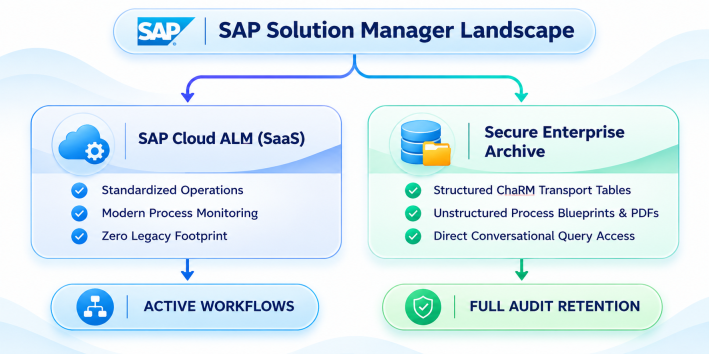
Organizations preparing for the December 31, 2027 mainstream support deadline for SAP Solution Manager (SolMan) 7.2 face a critical architectural obstacle. While SAP directs enterprises toward SAP Cloud ALM for future application lifecycle management, Cloud ALM operates as a standardized Software-as-a-Service platform. It does not ingest custom ABAP code extensions, multi-terabyte database traces, or historical Change Request Management (ChaRM) records.
Failing to plan for this architectural gap results in a costly dilemma. Teams either leave aging SolMan instances running in expensive read-only server states or perform blind data cuts that risk regulatory compliance failures during SOX or FDA audits. Enterprise architects and Basis leads need a structured method to decouple change management history from operational systems before sunsetting legacy hardware.
The ChaRM Data Retention Challenge
Change Request Management controls transport workflows, approvals, and code changes across enterprise landscapes. Years of operation create vast repositories containing regulatory audit trails, transport logs, and functional sign-offs.
When migrating to SAP Cloud ALM, these historical assets cannot be imported natively. Leaving them trapped in an expiring on-premise SolMan database forces infrastructure teams into maintaining unnecessary virtual machines, cloud storage tiers, and database licenses purely for historical lookup purposes.
Bridging the Gap: Structured and Unstructured Extraction
Effective application retirement requires managing diverse data structures. Solution Manager holds relational database tables alongside unstructured documents like PDF test sign-offs, functional specs, and process blueprints.
Modern archiving frameworks ingest both structured relational records and unstructured files into a single repository. Automated full-text indexing, metadata enrichment, and Write-Once-Read-Many (WORM) immutability protections secure all extracted SolMan artifacts, ensuring document-level discovery during audits.
Querying Archives Without Native System Restoration
Traditional data retrieval requires staging databases or restoring archives back into native application environments, adding technical overhead and infrastructure costs
Advanced data access frameworks eliminate this requirement by using specialized query languages designed for compressed and encrypted storage tiers. Authorized teams query, filter, and extract high-value historical records directly from storage without spinning up databases. Auditors retrieve past transport approvals or change histories instantly while leaving legacy servers permanently powered off.
Conversational Archive Access via Generative AI
Navigating historical records no longer requires writing complex database scripts or understanding proprietary SAP table layouts.
Generative artificial intelligence and natural language processing modernize enterprise archives. Through a conversational interface, compliance officers and IT managers ask plain English questions, such as “Retrieve all approved ChaRM transport requests for Finance releases in Q3 2024”.
Underlying query engines analyze the data model, execute searches securely, and export audit-ready reports in standard formats like CSV or SQL. This capability reduces audit response cycles from weeks to seconds while enforcing fine-grained user entitlements.
Managing historical data effectively requires modern architectural frameworks. In their report Use AI to Modernize Data Retention and Archiving (August 2026), Gartner highlights that while many organizations retain historical data, far fewer can use it effectively. Gartner advises infrastructure and operations leaders to apply AI to data archiving where poor data access blocks application retirement and trusted use of archived records.
Infobelt is recognized in this report for addressing these exact enterprise data governance challenges.