

_ _ Infobelt
Defensible Deletion under India’s DPDP Act. Why It Matters and How to Achieve It
The Digital Personal Data Protection (DPDP) Act, 2023 marks a turning point for how Indian enterprises manage personal data.
For years, organizations have hoarded data under the belief that more is better. The DPDP Act changes that. It asks a new question:
Should this data still exist?
Under the Act, personal data must be deleted once its purpose is fulfilled — unless a lawful reason exists to keep it. But deletion isn’t about pressing “erase.” It’s about proving control, intent, and accountability.
Welcome to the era of defensible deletion.
What Is Defensible Deletion?
Defensible deletion means being able to prove that data was:
- Correctly identified for deletion
- Securely and irreversibly removed
- Deleted through an auditable, approved workflow
It’s deletion that can stand up to regulatory or legal scrutiny.
The idea first took shape in GDPR and CCPA frameworks — and now, India’s DPDP Act gives it legal teeth at home.
Why It Matters
Proof of Intent and Control
Regulators don’t just ask “Did you delete it?” They ask “Can you show how and why?”
Defensible deletion provides a trail of evidence — who decided, who approved, and how the process was executed.
The Hidden Cost of Hoarding
Old data isn’t an asset; it’s a liability.
Every unnecessary record increases risk — of breach, misuse, and non-compliance under the DPDP’s storage-limitation rule.
Empowering Data Subjects
The DPDP Act gives individuals the right to erasure.
Meeting that expectation means knowing where personal data lives — across dozens of systems — and being able to remove it confidently and consistently.
What Makes Deletion “Defensible”?
Defensible deletion is not an IT function alone. It’s a cross-functional discipline that blends governance, process, and technology:
- Retention Rules: Every data category has a defined lifespan based on business and legal needs.
- Approval Workflows: Legal, compliance, and data owners jointly authorize deletion.
- Automation: Triggers fire when data hits end-of-life or when a user requests deletion.
- Secure Erasure: Data is destroyed permanently — with proof of action.
- Auditability: Reports and logs show what happened, when, and by whom.
Together, these steps create a controlled lifecycle — not just deletion, but deliberate, defensible disposal.
Achieving Defensible Data Deletion

Lessons from Global Privacy Frameworks
India isn’t starting from scratch.
Under GDPR and California’s privacy laws, global enterprises learned that defensible deletion depends on culture as much as code.
- Treat retention as strategy, not a default setting.
- Build shared ownership across legal, IT, and business.
- Embed automation and auditability at scale.
India’s DPDP Act is the next chapter — shaped by similar principles, but adapted to local realities.
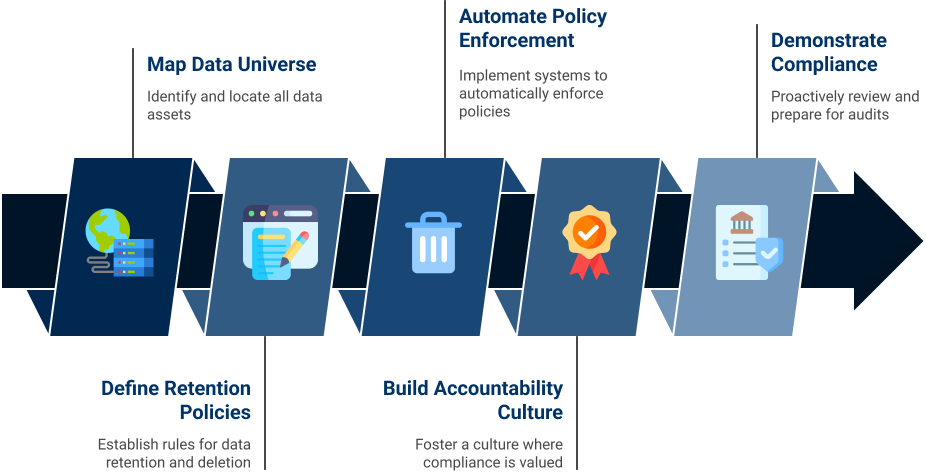
How Businesses Can Get Started
- Map your data universe → Know what you have and where it resides.
- Define purpose-driven retention → Delete what no longer serves a lawful or business need.
- Automate policy enforcement → Let systems, not spreadsheets, trigger deletion.
- Build a culture of accountability → Compliance is everyone’s job.
- Demonstrate compliance proactively → Review reports, simulate audits, and stay ready.
Data Destruction Process for Businesses
Beyond Compliance
Defensible deletion is not just a privacy requirement — it’s smart business.
It:
- Reduces storage and management costs
- Minimizes breach exposure
- Builds trust with customers and regulators alike
In a digital economy built on data, responsible disposal is the new mark of digital maturity.
Opportunities for Organizations
The DPDP Act isn’t just about compliance.
It’s an opportunity for organizations to rethink data governance, purpose, and trust.
Defensible deletion is the discipline that ties them together — ensuring that enterprises not only collect data responsibly but also know when and how to let it go.
Because in the age of digital abundance,
True intelligence lies in what you choose to keep — and what you choose to delete.